Why Node.js is Perfect for Building Fast Web Applications
Understand why Node.js is considered fast and scalable by exploring its non-blocking I/O, event-driven architecture, and single-threaded model in a simple, intuitive way.
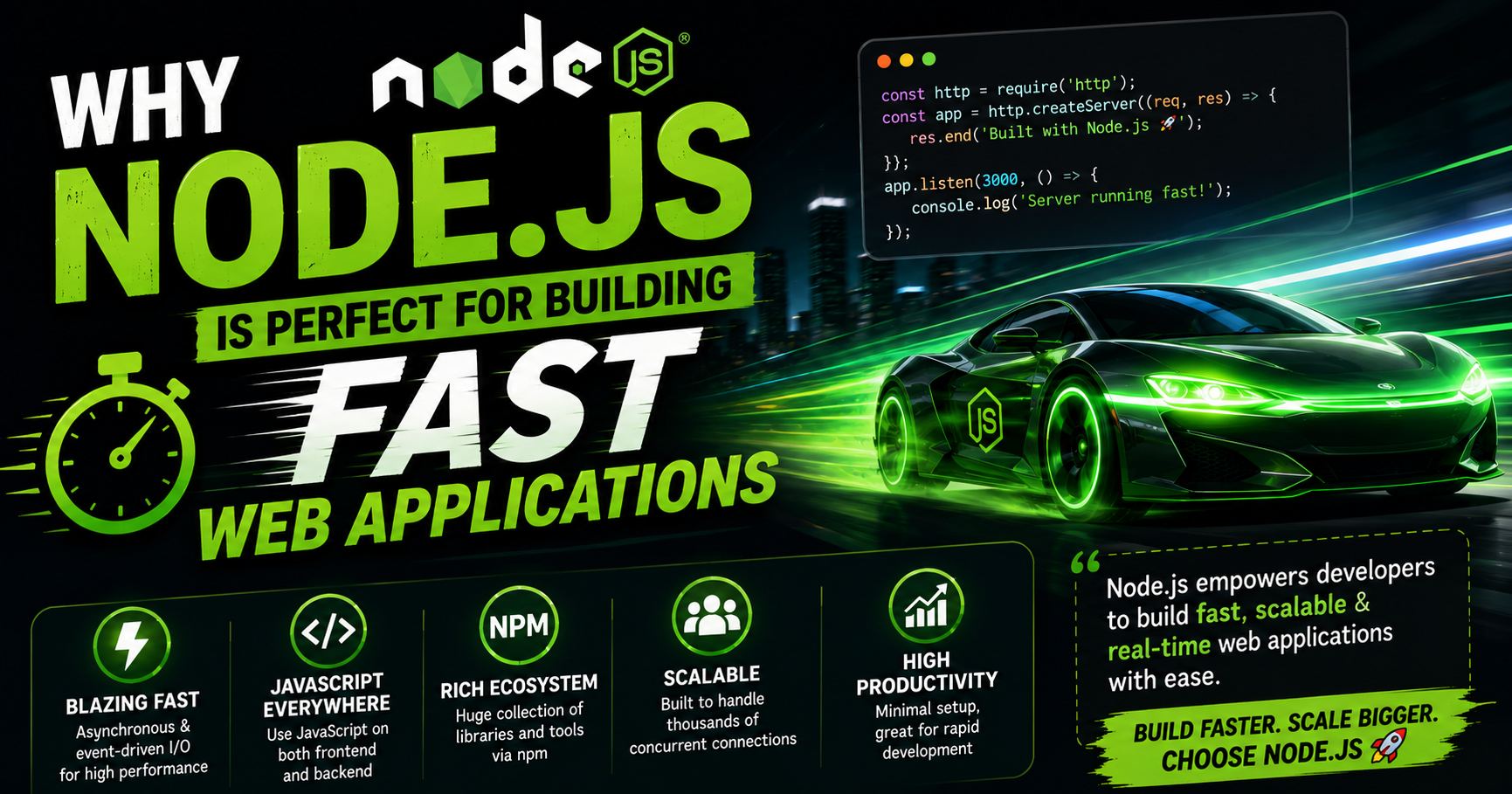
Introduction
Modern web applications need to handle thousands (or even millions) of users at the same time.
They must:
Respond quickly
Handle multiple requests simultaneously
Avoid freezing under load
Traditional backend systems sometimes struggle with this due to blocking operations.
That’s where Node.js stands out.
What Makes Node.js Fast?
Node.js is fast because it is built around three core ideas:
Non-blocking I/O
Event-driven architecture
Single-threaded event loop
These work together to handle many requests efficiently without creating heavy threads.
Blocking vs Non-Blocking (Simple Idea)
Blocking System (Traditional)
In a blocking system:
One request must finish before the next starts
Each user waits in line
Example:
Request 1 → Processing → Done
Request 2 → Waits
Request 3 → Waits
This slows down performance under load.
Non-Blocking System (Node.js)
In Node.js:
Requests don’t wait
Tasks are handled asynchronously
Request 1 → Start → Continue
Request 2 → Start → Continue
Request 3 → Start → Continue
This improves responsiveness.
Restaurant Analogy (Easy Understanding)
Imagine a restaurant:
Blocking System
One waiter handles one customer at a time
Next customer waits until food is served
Slow and inefficient.
Node.js System
One waiter takes orders from multiple tables
Kitchen prepares food asynchronously
Waiter delivers when ready
Efficient and fast.
What is Non-Blocking I/O?
I/O means:
Reading files
Database queries
API calls
Network requests
In Node.js:
I/O operations do NOT block the main thread
Instead, they run in the background and notify when done.
Event-Driven Architecture
Node.js works on an event system:
Something happens → event is triggered
Node reacts to that event
Example:
Request comes in → event triggered
File read completed → event triggered
Event Loop Concept
Node.js uses an event loop to manage tasks.
Simplified Flow:
Request → Event Loop → Task Queue → Callback → Response
Single-Threaded Model (Explained Simply)
Node.js runs on a single main thread.
But that does NOT mean it handles only one request.
Instead:
One thread manages many requests
Async operations are handled outside the main thread
Why Single Thread Works Well
Because:
No thread switching overhead
Less memory usage
Efficient request handling
Concurrency vs Parallelism
Concurrency (Node.js)
Many tasks managed at once
Not necessarily executed at the same time
Parallelism
Multiple tasks executed at the same time
Requires multiple CPU threads
Simple Difference
| Concept | Meaning |
|---|---|
| Concurrency | Managing many tasks |
| Parallelism | Running many tasks simultaneously |
Node.js focuses on concurrency, not heavy parallel execution.
Why Node.js Performs Well in Real Applications
Node.js is best for:
High traffic APIs
Real-time systems
Chat applications
Streaming services
Microservices architecture
Where Node.js Performs Best
1. Real-Time Applications
Chats
Notifications
Live updates
2. APIs
Fast handling of thousands of requests.
3. Streaming Services
Efficient data streaming without blocking.
4. Microservices
Small, scalable services communicating with each other.
Real-World Companies Using Node.js
Many large-scale companies use Node.js, such as:
Netflix
LinkedIn
PayPal
Uber
Walmart
They use it for performance and scalability.
Node.js Request Handling Flow
Client Request
      ↓
Event Loop Receives Request
      ↓
Non-blocking I/O Starts
      ↓
Callback Registered
      ↓
Other Requests Continue
      ↓
Task Completes
      ↓
Response Sent
Blocking vs Node.js Request Handling
Traditional Server
Request 1 → Wait → Finish
Request 2 → Wait
Request 3 → Wait
Node.js Server
Request 1 → Start → Continue
Request 2 → Start → Continue
Request 3 → Start → Continue
Why Node.js is So Efficient
Node.js achieves performance through:
Event loop efficiency
Async I/O operations
Lightweight architecture
Minimal thread usage
Key Advantages of Node.js
1. Fast Response Time
No blocking operations slow down requests.
2. High Scalability
Can handle many users simultaneously.
3. Efficient Resource Usage
Uses fewer system resources.
4. Great for APIs
Perfect for backend services.
Common Misconception
“Node.js is slow because it is single-threaded”
❌ Wrong
Node.js is actually fast because:
It avoids thread overhead
Uses async operations
Delegates heavy tasks efficiently
Real-Life Analogy Summary
Node.js is like a smart restaurant system:
One waiter (single thread)
Many orders (requests)
Kitchen handles tasks asynchronously
Orders delivered when ready
Conclusion
Node.js is perfect for fast web applications because it is built around:
Non-blocking I/O
Event-driven architecture
Efficient single-threaded event loop
Instead of waiting for tasks to complete, Node.js continues handling other requests, making it highly scalable and efficient for modern web development.
If your application needs speed, scalability, and real-time performance, Node.js is one of the best choices available today.


